Tai Po
What do you do with a city filled with grief?

Dear friends,
I haven’t written here in some time, partially because I didn’t want to write just for the sake of writing, and partially because I was exhausted. Each letter felt like a labour of love, but I didn’t have the bandwidth to attempt every week or month in a sustained manner. And how could I simply write about Hong Kong when there is so much happening in the world? The genocide in Gaza, war in Ukraine, Trump’s continual and sustained inhumanity, the ICE raids in the U.S., and just this evening, the news that the U.S. Coast Guard will no longer classify the swastika or the noose hate symbols of fascism or white supremacy. And now alongside the fire in Tai Po, deadly storms that have killed over 700 people across Sri Lanka, Indonesia, and Thailand. I didn’t know how to write about one thing, but nor did I know how to write about it all.
But I am going to try to begin somewhere. I sat down this morning to write, as I have done every morning for the last four days. Every night since the fire in Tai Po started, I told myself I would work on my new play the next morning. But every morning I would wake up to the news and updates about the fire and it felt increasingly absurd, the idea of sitting down to write my play when my mind and heart have been elsewhere entirely. So this morning, instead of opening my play to write a new scene, I decided to sit down and write about the Wang Fuk Court fire that began last Wednesday in Hong Kong.
I wrote this letter, thinking it was just that – one letter, but it quickly became apparent to me that there was too much for one letter to contain. So I will write more in the days and weeks to come.
I began this substack to write about the history and current ongoings of the 2019-2020 Hong Kong protests, and the changes that came thereafter. Now, I’d like to make this a place to continue writing about Hong Kong, as this letter does, as well as the rest of the world and my musings on writing, the world, grief, political action, how we can take change, gather in community, and much more. And I’d like to do it in a sustainable way.
To that end, I’d like to gently mention a change I’m making. I have added the option to become a paid subscriber here, if you are interested and able. I am going to keep all my posts public, to maintain accessibility. I don’t want a paywall to be a reason anyone cannot access my letters. But if you are so inclined, I would deeply appreciate your support via a subscription, if you are willing and able.
If you click to subscribe below, you have the option of either subscribing for free or for a minimal subscription fee. You are also more than welcome to subscribe for free and choose to Venmo me @StefKuo. You’d be able to bypass fees and the cut that substack takes. Any and all support will help me continue writing and creating.
what happened?
I don’t want to belabour this letter with the facts, but I feel it is important to reiterate them, in order to honour the victims, survivors, and the gravity of what has happened.
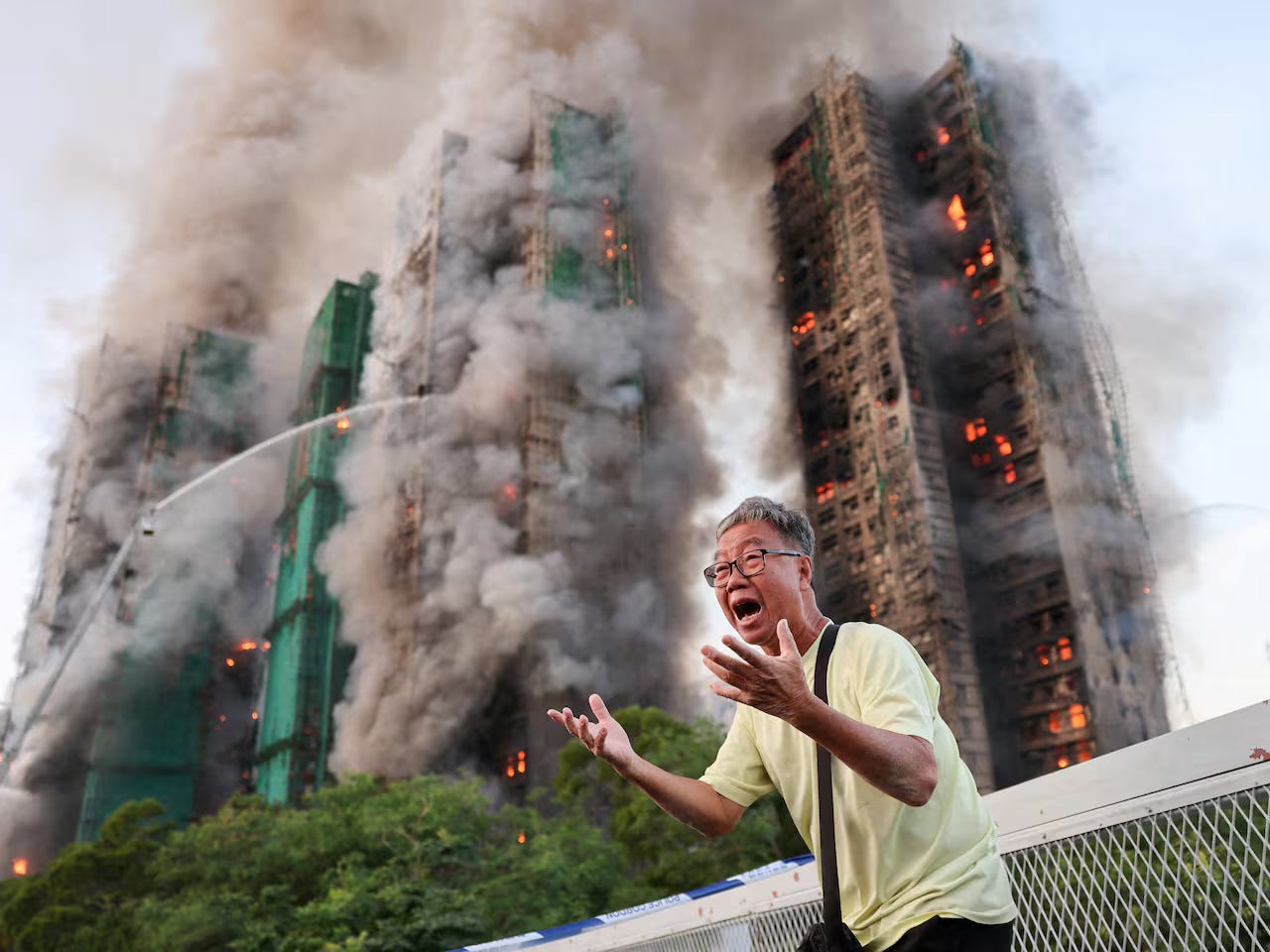
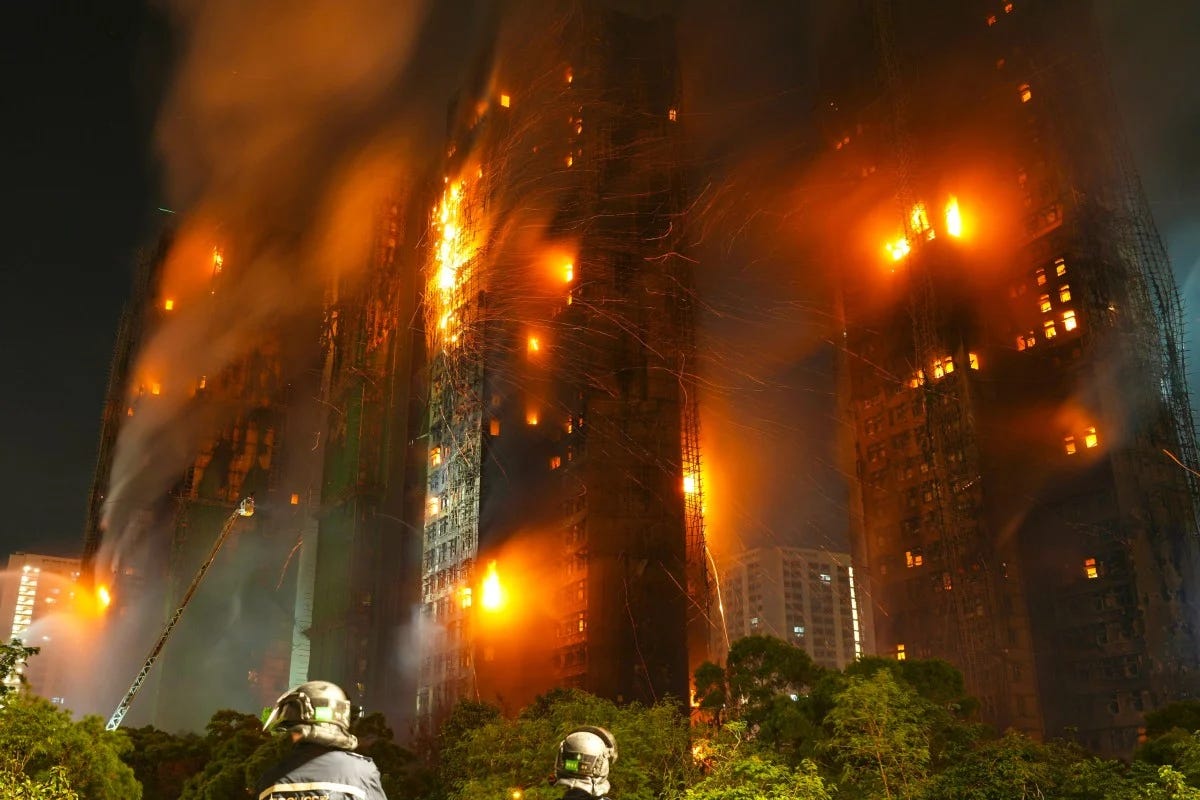
Last Wednesday, on November 26th, a fire broke out in Tai Po, at an apartment complex made up of eight buildings called Wang Fuk Court. It began at 2 pm, but was only first reported at 2:51 pm. Firefighters arrived ten minutes later, but the fire had already spread rapidly. By 3:34 pm, the fire had gone from a level 1 fire to a level 4. By 6:22 pm, it was raised to a level 5, the highest class of fire in Hong Kong. The fire burned for 43 hours and 27 minutes. It spread from block F, the first block that caught fire, to six other blocks. Only one of the eight buildings did not catch fire.
As of today, 146 people have been reported deceased, 79 injured, and still 140 missing or unaccounted for. Among those dead and missing are not only Hong Kong residents, but also migrant workers from the Philippines and Indonesia. The firefighters have searched two of the seven buildings, two which were the least severely burned. The remaining buildings were the most severely burned, and will take up to four weeks to thoroughly search through. While the fire was active, temperatures rose up to 930 degrees Fahrenheit, and even a day after the fires were extinguished, the temperatures within the buildings remained at 330 degrees Fahrenheit, so firefighters were unable to enter and thoroughly search until the temperatures dropped.
There are countless articles with the facts. There is a new multimedia timeline of what happened from the SCMP. There is a new Wikipedia page: “Wang Fuk Court Fire.” There will continue to be many more. It feels eerie, reading this Wikipedia page. This event is now marked in history. But it is still happening. Five of the seven buildings remain unsearched. There are still missing people, missing victims. There are still bodies waiting to be identified, families waiting to be relocated. Citizens waiting for answers. Why does the word “fire” not feel sufficient? Or the word “tragedy?” Or “murder?” Why do the numbers not hold the depth and scope of the horror and grief of what is happening?
a visit to Tai Po: what do we do with the grief?
Since I was a child, writing has been my solace. I started writing poetry to understand my emotions, diary entries to process things happening around me that I did not understand. I wrote letters to family and friends to say what I could not articulate in person, and wrote plays to share experiences with people that I could not describe except through immersion. But at every turn, the irony of writing is that I have found language to be completely and utterly insufficient.
There are no words to describe grief. There is no language that can transfer tragedy.
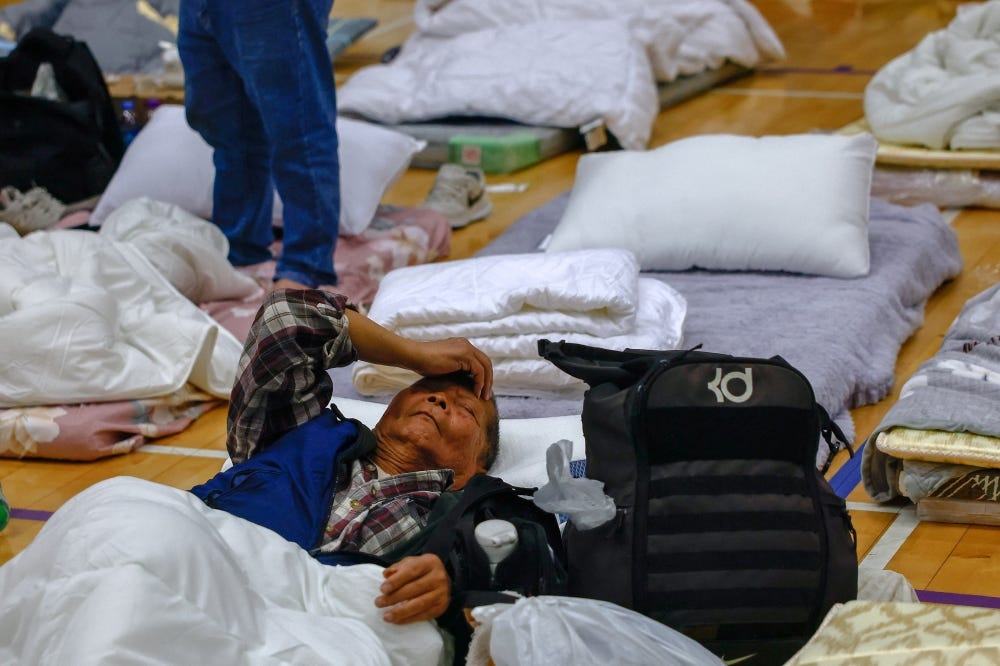
Two days ago, I went to Tai Po with a friend. I had just gotten back from Taipei, where I was helping take care of family. On my way home from the airport, I called each of the shelters in Tai Po, the ones set up in community halls and centres, churches and housing projects. I asked each one if they needed help, more volunteers. Each one of them insisted they did not, there were already too many volunteers, too many donations. I left my number with a few places, just in case they found themselves in need of more help in the days and weeks to come.
After asking several friends, I received an invitation link to a Telegram group for volunteers. The group is big, and only growing bigger. As of right now, there are 23,424 members in it. And there are subgroups. Subgroups for each district, for drivers offering vehicles and help driving people or supplies around, for mental health professionals willing to offer their services and time, for legal volunteers, for volunteers at different locations sorting through donations. The big group is overwhelming, with hundreds of messages appearing every hour. But through messages in the group, we found they were looking for volunteers on Friday evening in Tai Po, to help sort out donated supplies.
An hour or two before we left home for Tai Po, there was a message in the group. There were too many volunteers signed up for the shifts. Please. No more volunteers. We had signed up earlier, so we decided to still go.
I couldn’t remember the last time I was in Tai Po. It had only taken us thirty minutes on the MTR, and we’d signed up to help sort out donations at the Tai Po Market MTR stop, exit B. When we got there, the first thing we saw was a sign with an arrow pointing towards the donation collection area. Underneath the sign was a smaller sign, in a red rectangle: “no longer accepting donations.”
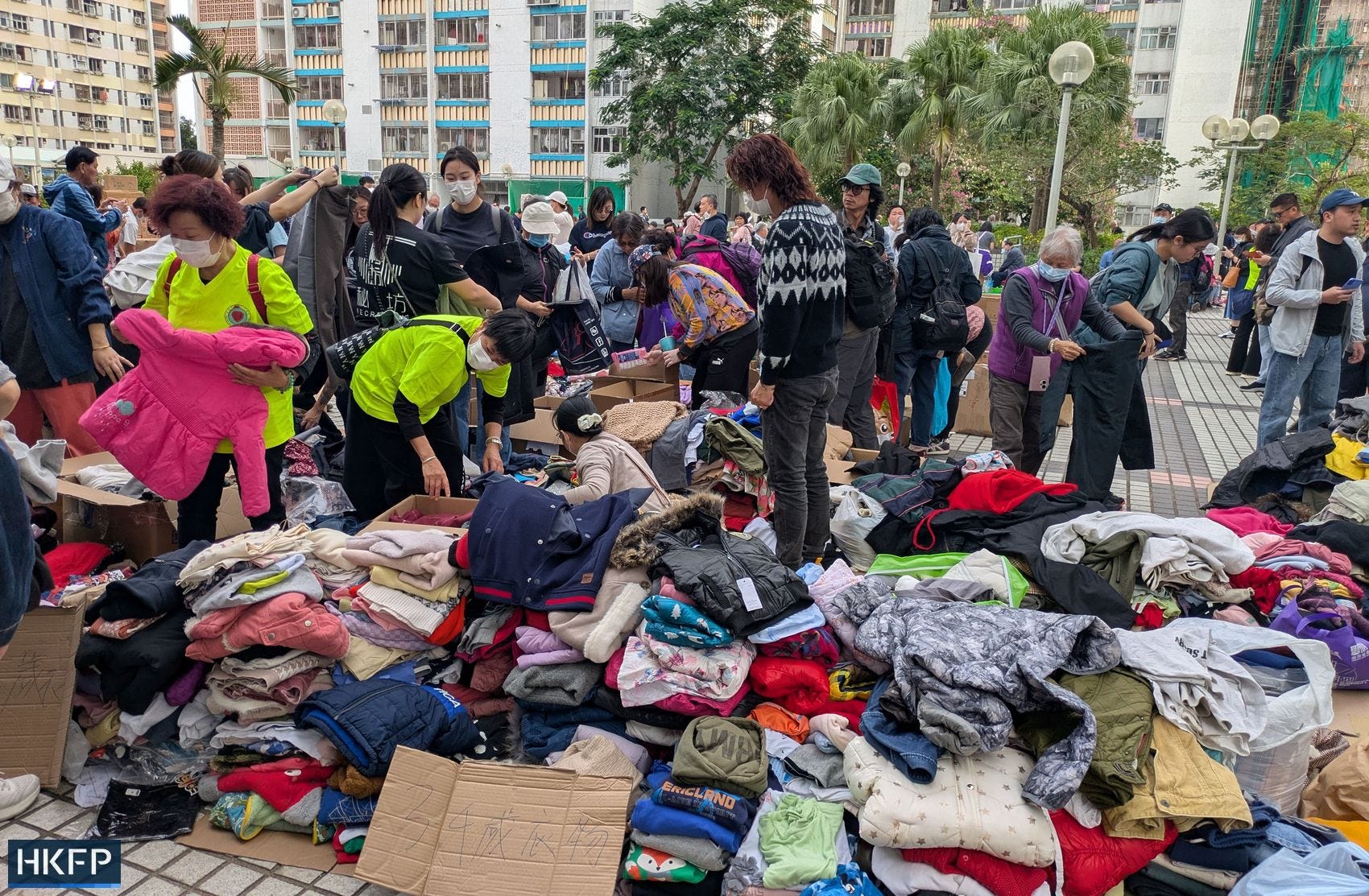
We turned a corner from the exit and there were people crowded around multiple piles of boxes and bags. There were paper signs taped up onto the wall behind them printed with categories: socks, pillows, blankets, medical supplies, masks, towels, hand warmers, water, toothbrushes and toothpaste, toilet paper, etc. There were items in cardboard boxes, and others in red, white and blue canvas bags, a Hong Kong staple.
My friend and I looked around, wondering who to speak to, but it quickly became clear that there was nobody to report to, but rather, several volunteers who were shepherding people, mostly through loudly yelling over the commotion. Soon, we found ourselves next to a pile of toilet paper. Two men were moving toilet paper from a stack onto a pallet, yelling for the smaller packs on the backside of the pallet. What began as four people passing toilet paper over a two meter distance quickly became ten people passing toilet paper hapharzardly in the dark. Over each station a volunteer was holding a light over the boxes akin to the light atop an angler fish’s head. Soon a woman was yelling, “Too many people! There’s too many people moving toilet paper! It’s not necessary! It’s too much PRESSURE on the TOILET PAPER!” I moved aside and bit my lip, trying not to laugh.
It wasn’t that we didn’t want to take it seriously. On the contrary, it was the fact that Hong Kongers are taking this so seriously. Every single Hong Konger I know wants to help. People are donating blood, donating their time, their money, their resources. People are so desperate to help they are cramming themselves in to try to move toilet paper across a two meter distance because how can we watch from the sidelines and not step in?
Even in the chaos, there was a kind of organising principle, a spirit, a Hong Kong spirit. It reminded me of the 2019 protests, and the movement that came with it. How you could feel Hong Kongers’ spirit fighting to remain generous, kind, open, and hopeful, even in the grief, desperation, and despair.
We left the volunteer station, sensing that we were more in the way than we were helpful, and decided to walk towards Wang Fuk Court, which was only a few minutes away. We walked around the bus terminus, towards the river. I looked up to the right and there they were. It was almost 8 pm at night, so it was dark, but we could see the buildings, dark across the river. It felt unnatural, seeing these high rises with their windows completely dark at dinnertime. I started to smell smoke and said to my friend, “I can smell it, even from here.” They said they could too, but then pointed at an older man in front of us: “But it also might be that? He’s smoking?” I laughed. It probably was just his cigarette. I felt nervous. Part of me wanted the smoke I smelled to be from the buildings, as if it would be easier for it to creep up on us than for it to become real all at once when we got there.
As we crossed the bridge, the water was still. There were boats anchored in the water, which moved slightly with the wind. As we came to the other side of the river, there were dozens of firetrucks parked on the road. The buildings came closer, and we could see the police had cordoned off the roads leading towards the complex. People had left and continued to leave white flowers on the ground and in front of a statue in the park we stood in, paying their respects to the dead. Dozens of people stood in front of the building. It was quiet. We stood there for a long while. It didn’t feel sudden, the way I had been afraid of as we walked towards the building. But anything that I had previously intellectualised or made abstract about the fires all felt real in the face of the charred, darkened buildings.
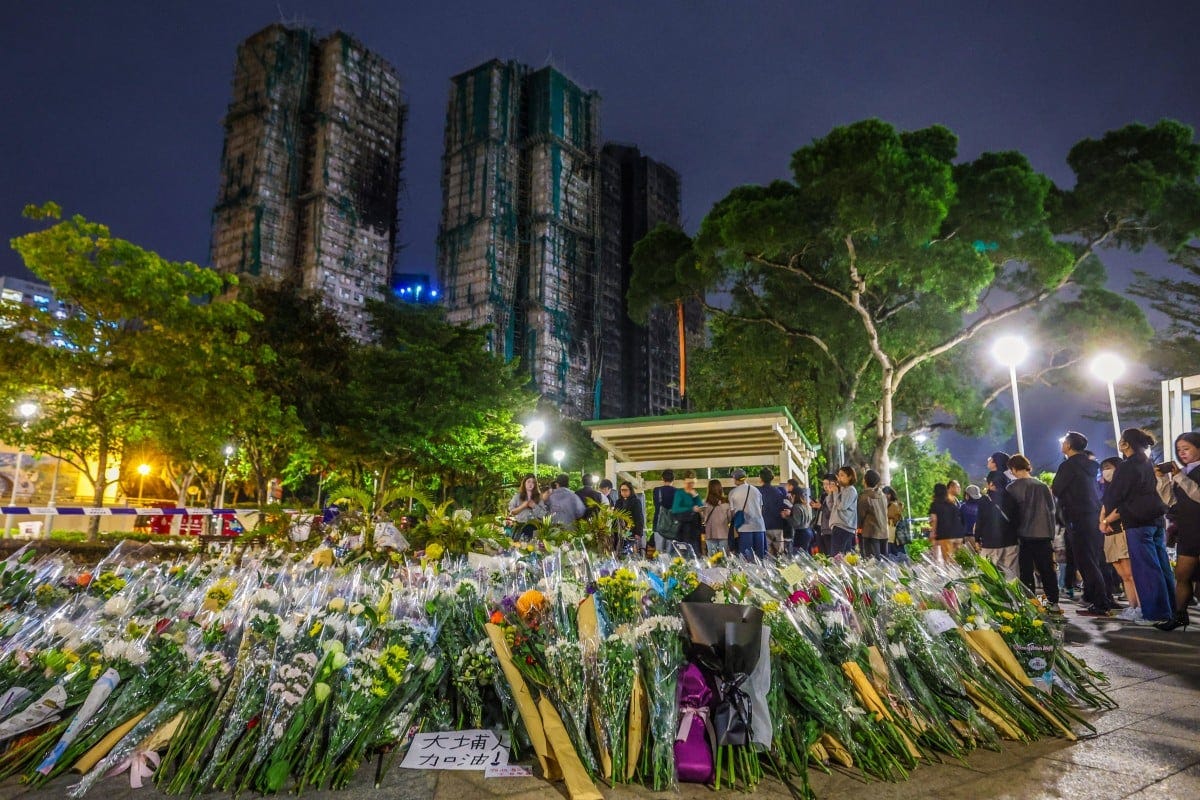
I looked at the buildings. From where we stood, I could only visibly see six of the eight in the complex. The ones to the left were much less severely burned than the ones to the right. You could still see most of the bamboo scaffolding intact, but the green mesh had almost entirely disintegrated, along with most of the Styrofoam inside that had been covering the glass windows. Suddenly, I saw a flash of light. I said something to my friend, then took it back, wondering if it was just a reflection. But no, it was light. We could see the lights moving every so often within the buildings, firefighters searching inside the buildings.
Two days ago, those lights would not have been searchlights. They would have been lights in individual units as families ate their dinner, watched television, played mahjong, did laundry, lived their lives. Now, where were they?
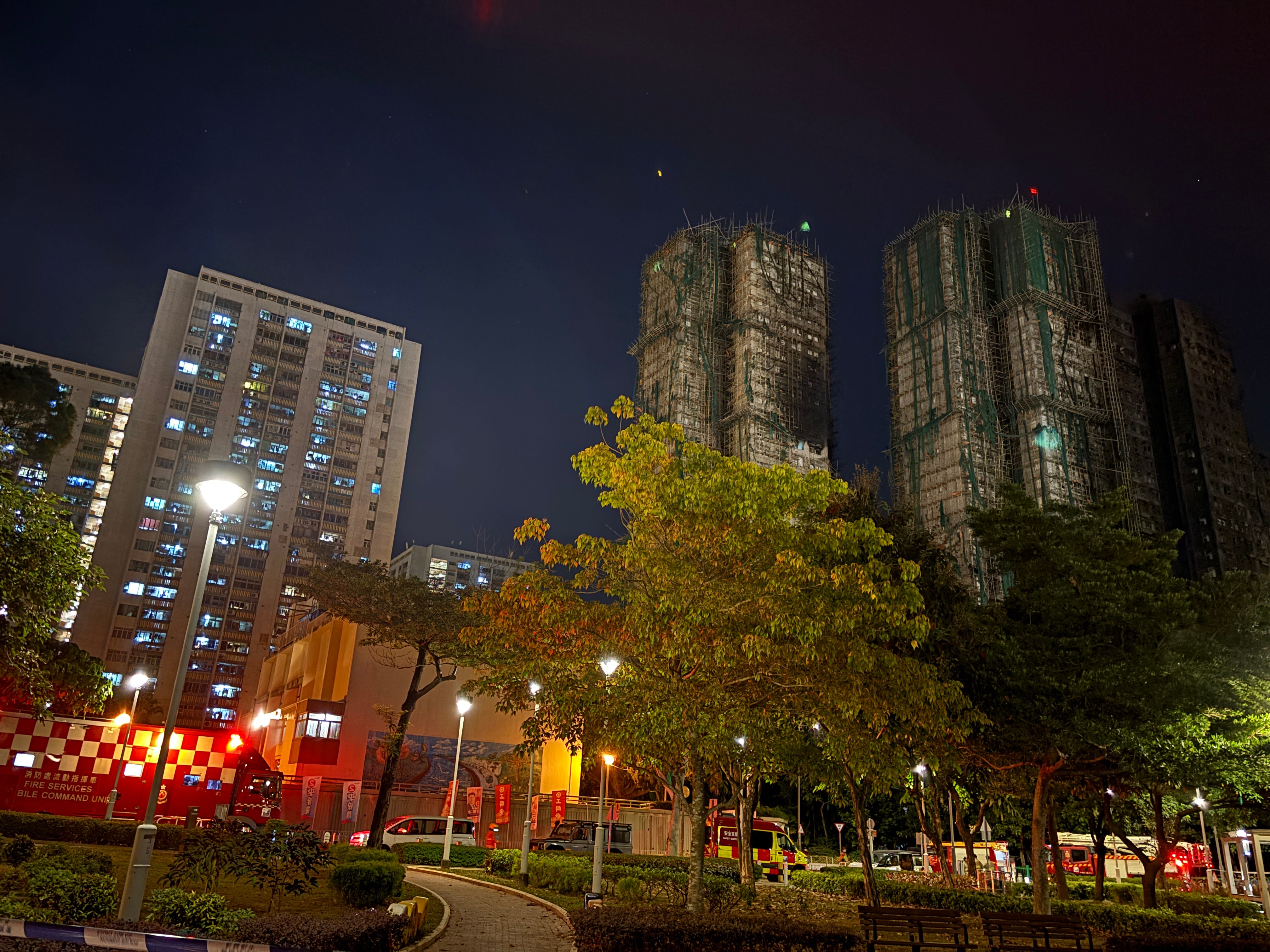
In the quiet, we heard a cart rolling through the park. A woman came through with a vat of tea, “anyone want ginger tea? We volunteers boiled some ginger tea for anyone who wants some. Anyone want ginger tea?” I watched her roll the cart with a fellow volunteer through the park, until their voices disappeared.
On the ride home from Tai Po, there was a family next to us, two young adults my age and three adults who looked like their parents. They each held a plastic bag of donated clothes and goods, and spoke about their grandmother, who had perished in the fire. They joked about the bedside drawer their grandmother kept secret things in, how there was a piece of paper with the names of someone she never told them about. Who was that secret person? Why was she so secretive about them? And would they really never know now that she was gone?
It felt strange being able to hear their conversation. I felt guilty. I felt confused, standing on the MTR, surrounded by people who appeared to mostly be going about their daily lives, scrolling through their phones, taking the train back home or wherever they were going. Even this family, standing next to a pole on the MTR, appeared eerily normal. Who else on this train was holding this grief, this trauma, this confusion, that I simply couldn’t see? I felt guilty, wondering if this family was in the complex too, if these were their clothes, or if they had been donations. I looked up and saw one of the daughters holding her mother, who was on the verge of tears. When they first got on the train I had noticed that all of their eyes were swollen from crying.
That night, I went home and read the story of an older man who was in one of the buildings with his daughter-in-law when he realised he was likely going to die. She had wrapped him in two wet towels, for the smoke. She said he was calm, ready to face death, but that he was still afraid of one thing: that his family would not find peace because they would not know how to identify his body. She said he held his Hong Kong ID card until the end, just in case, so they would know it was his body when they found him.
I called my mother that night and cried. How could the building’s owners allow this to happen? How could the contractors skimp on materials and endanger these thousands of residents? How did the government officials let this slide?
What do you do with a city filled with grief? What do you do with grief that can go nowhere except towards more grief?
I read articles and accounts of survivors for hours. I open the Telegram group to calls for help – calls for drivers to help move supplies, for mental health professionals to come support families as they identify their loved ones’ disfigured bodies. I watch the news obsessively, knowing the death toll will only get higher.
This morning, I opened the New York Times and there was no longer a section about Hong Kong on the front page. Instead, there was a new article: “Mourners Line Up to Honor Victims of Hong Kong’s Deadliest Fire in Decades.” When I clicked into the article, the sub-headers came back. The article was filed under “Mourning the Victims.” I looked at it for a long while. How do you neatly file “mourning” away like that? How can the news encapsulate tragedy? How can it articulate a mourning that will take place not only over the course of the next weeks and months, but for years and generations to come, a grief that has shaken each and every Hong Konger to their core, and is not going anywhere?
how do we keep on living?
I haven’t written on this substack in a year and a half because it has felt too difficult, because I have felt guilty, confused, and ashamed. There is so much darkness in the world. How am I to write about Hong Kong when so much injustice and horror is happening in the world? How do I write about this fire when I was not a personal survivor, when I am writing this from my living room in Hong Kong, where I am safe, drinking water from a pipe that has not been shut off the way residents’ water supply was cut off during the fire in Tai Po when they needed it most to wet towels to keep smoke from coming in from under their doors?
How can we continue living our lives in relative comfort when there is so much to do in the wake of this tragedy? When there is always so much to do in the world? How do we continue on?
Every day I see stories of hope. I see Hong Kongers supporting one another, reaching out for one another. In the darkest of times, I hope we can hold onto that hope and spirit. I don’t have many answers, but I hope that in sharing these thoughts, maybe you will have some to offer. Or maybe this can be a place for questions, for living.
In the meantime, here are a few resources with information on how you can support those in need as a result of the fire in Tai Po:
a guide from the Hong Kong Free Press
a guide from the South China Morning Post
a guide from Hands On HK
I’d like to note in particular the work that Mission for Migrant Workers is doing to support migrant workers working in Hong Kong and donating to their continual efforts to support workers such as the Filpina and Indonesian women who have been severely affected by and killed in the fire.
I am sending love to each and every one of you, to each and every victim and survivor of the fire, to every single volunteer who has helped and continues to help in these dark times. Perhaps it is in these dark times that we learn who we can walk alongside to continue on.
Much love,
Parachute 香港人
Welcome back after "many years"! You bring us to witness the aftermath of the tragedy only words can do, leaving us room to feel, in this uncertainty and this is how we can truly connect in a way words can't do. Amidst the darkness, your story witness the hope and enduring goodness in our nature. That is the prevailing force that we have become who we are. After reading "The Better Angels of Our Nature" by Steven Pinker, I like to quote "The arc of the moral universe is long, but it bends toward justice". Martin Luther King Jr. "God, grant me the serenity to accept the things I cannot change, the courage to change the things I can, and the wisdom to know the difference." by Reinhold Niebuhr. Your writings can't be taken lightly. It touches our hearts and souls.
in the face of insurmountable tragedy i take comfort in the following:
1. nature’s uncanny ability to heal. little green shoots will germinate through the concrete long after we’re gone, taking back what was never rightfully ours.
2. there will always be those of us who show up; who attempt. to stay informed, to write, or aimlessly sort through the metaphorical toilet paper. humanity is won in the face of certain defeat, after all.
i’m grateful that you wrote this. that you haven’t thrown in the towel. that you still care deeply & openly even when it all feels so thoroughly insurmountable.
it may often feel like we’re screaming into a void, but there will always be those who who want to listen. & perhaps it will give them the strength to put out their own little fires, wherever they may be.